Independent guide to Binghamton, New York · What's happening this week
Binghamton NY GuideGo-to spot for what's happening
Home › Things to do › Ross Park Zoo

Ross Park Zoo — Binghamton's 150-year-old zoo

Founded in 1875 on South Mountain, the Ross Park Zoo calls itself America's fifth zoo. Here's what to know about its history, red pandas and Wild Encounters, the free carousel next door, and planning a visit — all sourced from the zoo and public records.

Overview and location

The Ross Park Zoo sits on the northern face of Binghamton's South Mountain inside Ross Park, a city park on the South Side. The zoo's street address is 60 Morgan Road, Binghamton, NY 13903. It is a compact, walkable zoo of winding wooded paths rather than a big-city safari park — the zoo describes its collection as 34 species — which makes it an easy half-day for families, especially paired with the antique carousel by the entrance.

The zoo shares a campus with the Discovery Center of the Southern Tier, a hands-on children's museum. The two are not affiliated and have separate admission and hours. The zoo's own directions put it simply: if you see a brightly colored cow statue, you're at the Discovery Center and have gone too far.

The zoo is run by the nonprofit Southern Tier Zoological Society under a contract with the City of Binghamton. Between 2005 and 2020 it was branded the "Binghamton Zoo at Ross Park"; it has since returned to the Ross Park Zoo name.

History: one of America's oldest zoos

According to the zoo, Ross Park Zoo officially opened in 1875, making it the fifth-oldest zoological institution in the country, behind Philadelphia, Chicago, Cincinnati, and Buffalo. In 2025 it marked its 150th anniversary.

The land came from Erastus Ross, a wealthy Binghamton businessman who donated a 90-acre plot to the city on the condition that it be used as a park the whole community could enjoy. When Binghamton's first electric trolleys arrived in 1887, a line up Park Avenue (via the old Washington Bridge) made the park an easy outing. A roller coaster, swings, and other amusements followed, and the stone entrance pillars went up in 1896 to greet visitors arriving by carriage or trolley.

The zoo says 1919 brought a bear exhibit and the park's carousel. After that, the automobile let families travel farther for recreation, and two World Wars and the Great Depression deepened the zoo's decline — to the point that the U.S. Department of Agriculture threatened closure.

In 1966, residents formed the Southern Tier Zoological Society to save it. A city appropriation for zoo maintenance first appeared in Binghamton's budget in 1972, and in 1977 the Society took over operating and maintaining the zoo under contract. The zoo was first accredited by the Association of Zoos and Aquariums (AZA) in 1987 and re-accredited in 1992, 1997, and 2009; it later lost accreditation (2014, per Wikipedia's sourcing). Today the zoo says it is working toward re-accreditation through the AZA's Pathway Toward Membership program and remains a USDA-licensed, inspected facility. Asphalt and steel bars have given way to naturalistic, wooded exhibits, and the zoo's education outreach serves more than 40,000 people in New York and Pennsylvania.

Animals and exhibits

The zoo's current animal list (checked November 2026) spans mammals, birds, and reptiles and invertebrates. Highlights include:

  • Endangered and big-name species: red pandas, American red wolves, Amur leopard, Canada lynx, and Pallas's cats.
  • Small cats and foxes: sand cat, Arctic fox, and fennec fox.
  • Primates and tree-dwellers: black howler monkeys, black-and-white ruffed lemurs, Geoffroy's marmosets, Linnaeus's two-toed sloth, and a binturong — the "bearcat" that is also Binghamton University's mascot.
  • Birds: African penguins, snowy and barred owls, cinereous and black vultures, green aracari, and Indian peafowl.
  • Reptiles and more: a green tree python, curlyhair tarantula, and several tortoise species (African spurred, pancake, red-footed, yellow-footed).
  • Farm and contact-style animals: alpine and pygmy goats, Shetland sheep, Flemish Giant rabbits, chinchilla, bantam chickens, armadillo, and porcupine.

Collections change as animals arrive, move under Species Survival Plans, or retire, so check the zoo's animal page if you're going to see one specific animal. Older guides and reviews mention species (such as a snow leopard or spectacled bear) that aren't on the current list.

Red pandas and the Red Panda Wild Encounter

The red pandas are the zoo's most-searched animals, and the zoo's signature paid experience is the Red Panda Wild Encounter, held in a dedicated encounter space attached to the red panda habitat. You meet animal care staff, learn about the species, and get the chance to offer food — though, as the zoo notes, it's up to the pandas how much they participate. Hands-on touching is restricted.

Per the zoo's encounter page as of November 2026:

  • Group encounters (Fridays and Saturdays) are $300 per group of up to 4 people.
  • Individual spots (Mondays) are $75 each; up to 4 unrelated people may share the session.
  • Every participant signs a waiver; under-18s must be accompanied by an adult and need a parent/guardian signature. Encounters are non-refundable.
  • The zoo was booking dates through December 2026.

Pricing, days, and availability change — book and confirm on the zoo's Wild Encounters page.

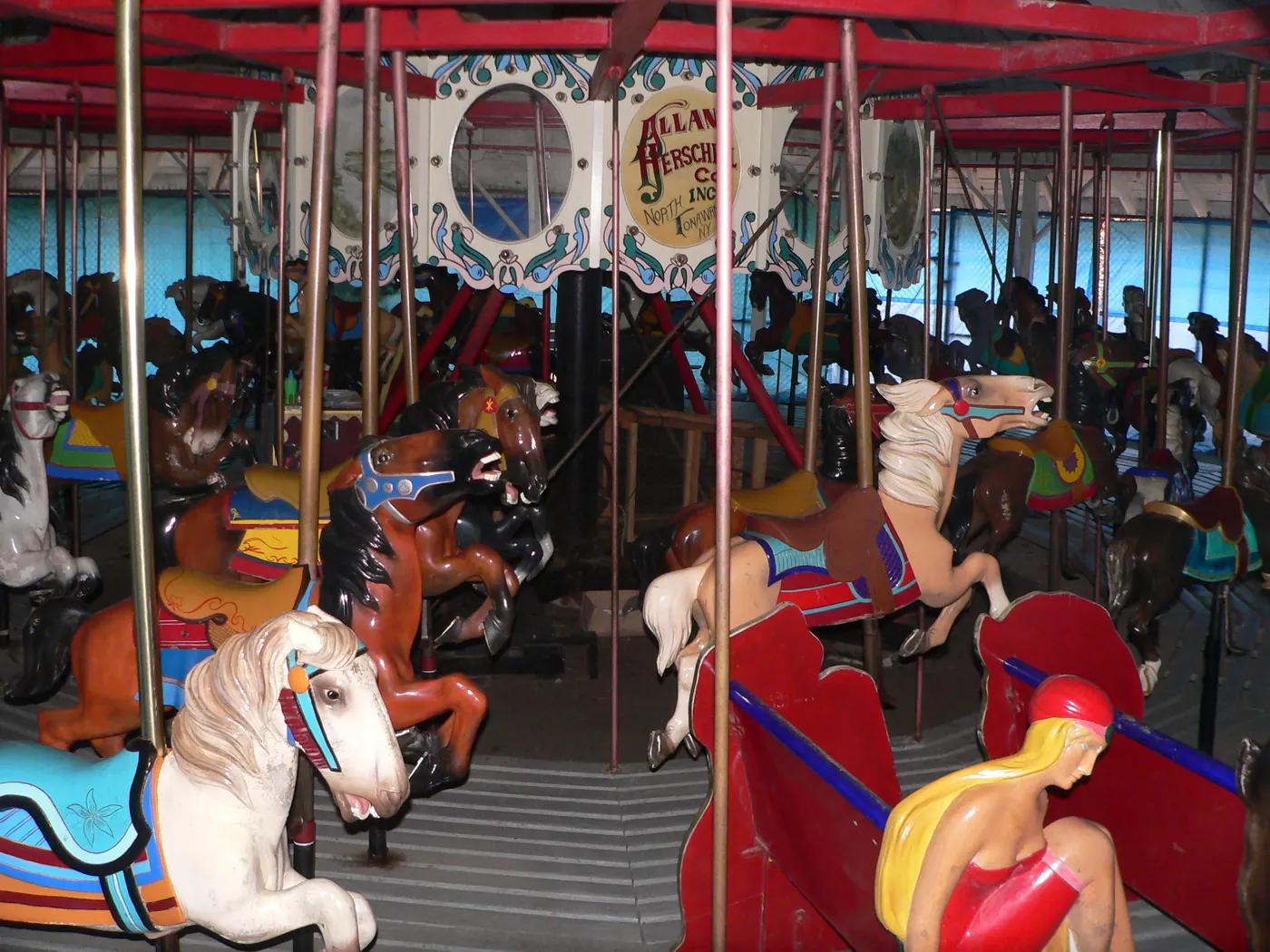
Carved horses on the Ross Park Carousel next to the Ross Park Zoo in Binghamton
Photo: Ammodramus · CC0 1.0 · Wikimedia Commons

Right by the zoo entrance is the Ross Park Carousel, one of Greater Binghamton's six antique Allan Herschell carousels donated by George F. Johnson. City and county listings put its installation at 1920 (the zoo's history dates the carousel's arrival to 1919): 60 jumping horses four abreast, chariots, and a Wurlitzer band organ. Rides have historically been free, per Johnson's wish, and the carousel runs in a summer season (historically Memorial Day weekend through Labor Day) — it doesn't operate in winter. See our guide to all six carousels and confirm hours on the City of Binghamton carousels page.

Discovery Center next door

The Discovery Center of the Southern Tier is a hands-on children's museum on the same Ross Park campus. With the zoo, the carousel in season, and the park's playgrounds and picnic pavilion, it's easy to build a full family day — but buy admission separately and check each site's hours. More ideas on our kids & family page.

Seasonal events

The zoo runs a rotating calendar of community events. For Halloween 2026 it hosted Zoo & Treat (Saturday, Oct. 31), with costumes, decorations, and candy around the zoo for the price of admission. Over the years the zoo has also held events such as Boo at the Zoo, Eggstravaganza, Ice Cream Safari, and Zoo Brew & Wine Too — but names and dates vary year to year, so treat those as history, not a schedule. The zoo may close early on special-event days; check the zoo events page and our Binghamton events listings.

Hours

Per the zoo's site (checked Nov. 4, 2026): open every day, 10 am–4 pm, last admission 3 pm. Closed Thanksgiving and Christmas Day. The zoo may close for bad weather or close early for events — check its social media or call before a special trip.

Hours & directions →

Admission

Listed prices effective Sept. 1 through Memorial Day: general admission (ages 3+) $8; groups of 10+ $7 each; Museums for All (SNAP/EBT/WIC, up to 4 people per card) $3; ages 2 and under and zoo members free. Summer pricing may differ.

Current admission →

Getting there & parking

60 Morgan Road, Binghamton, NY 13903 (mailing address: 185 Park Avenue). Once on campus, turn right at the stop sign by the bus stop and head down to the zoo gift shop lot, the closest to the entrance. If it's full, use the other campus lots and walk down. Follow the zoo signs, not the Discovery Center's.

Contact & tips

Phone 607-724-5461 (ext. 300 for event-day questions), [email protected]. Paths are wooded and hilly, so wear walking shoes. Outside the gate there's a pavilion with grills, a small park, and restrooms. Reviews and photos: see the zoo's Google and social listings.

rossparkzoo.org →